


Get in Touch With Attiroof
For top-tier, custom roofing solutions, trust Attiroof. Our commitment to quality and service is unmatched. Reach out to start your project today.
Oct. 28, 2026
UPVC Roof Sheet Bending Test: How We Check Quality Before Shipment
When purchasing UPVC roof sheets in bulk, thickness, color and price are easy to compare. What is more difficult to judge is how the material behaves under concentrated mechanical stress. Will the edge crack easily? Will it snap after repeated bending?
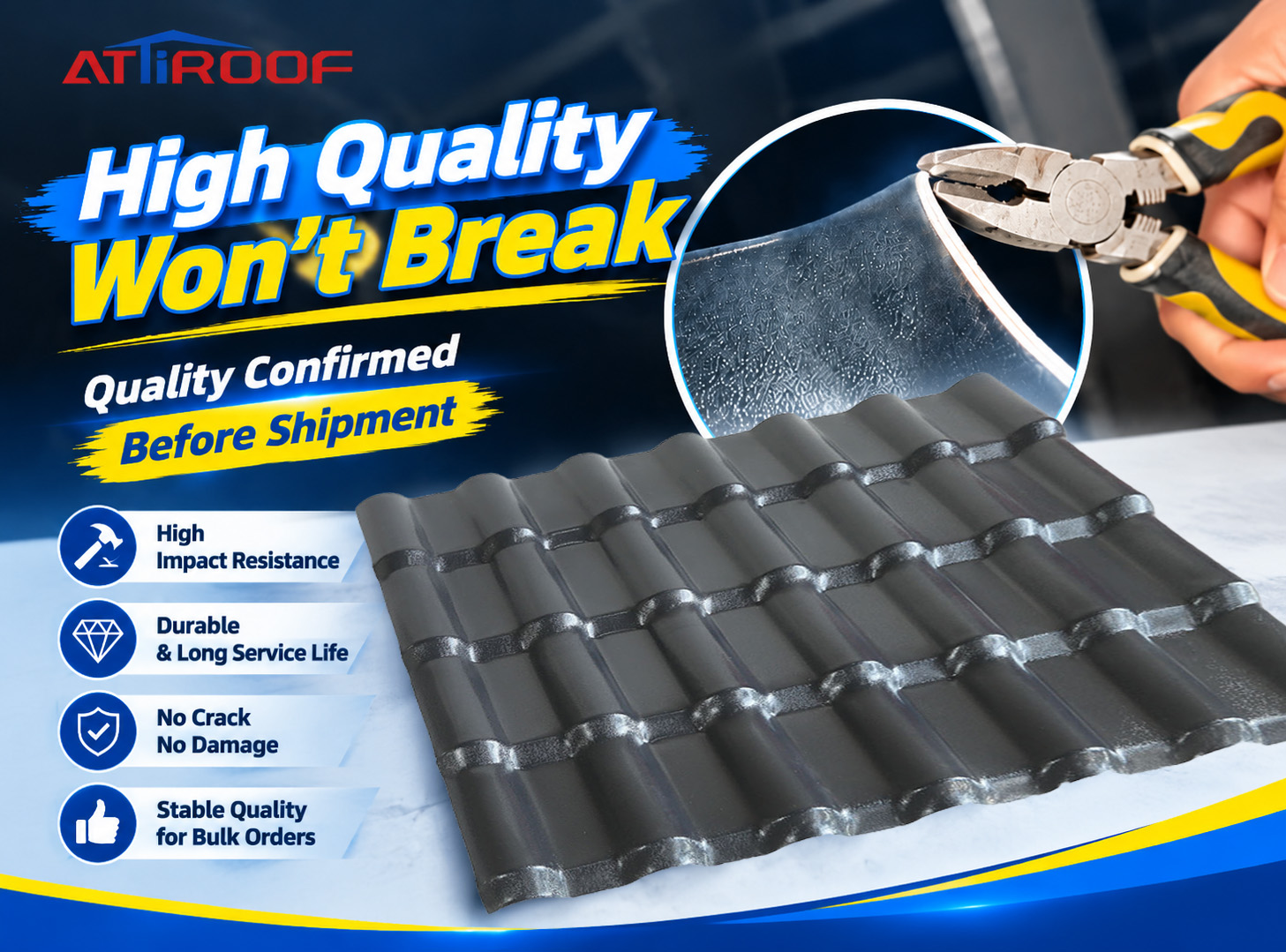
These questions matter to importers, distributors, roofing suppliers and project contractors because roofing sheets pass through manufacturing, stacking, container loading, international transport, unloading and installation before they are fixed onto a roof.
At ATTiROOF, finished roofing sheets are randomly inspected before shipment. One practical inspection is a repeated edge-bending quality check. In the test shown here, a worker uses pliers to grip a small edge section of a finished 2.5 mm 1050# UPVC roof sheet and repeatedly bends the same area through an angle greater than 90 degrees. The same point is bent no fewer than 10 times.
After this severe bending, a visible white stress mark appears at the bending point. However, the tested section does not show a visible crack and does not break apart. This article explains what we check, why the white mark appears, and what B2B buyers should consider when evaluating UPVC roofing sheet quality.
| Specification | Test Product |
|---|---|
| Product | 1050# UPVC Roof Sheet |
| Overall Width | 1050 mm |
| Effective Width | 960 mm |
| Thickness | 2.5 mm |
| Length | 3 m |
| Color | Red |
| Weight | Approx. 5 kg/m² |
| Surface Layer | ASA ultra-weather-resistant layer |
| Main Body | PVC resin-based compound |
The product used was our 1050# ASA UPVC roof sheet: overall width 1050 mm, effective width 960 mm, thickness 2.5 mm, length 3 m, red color and approximate weight 5 kg/m². It has an ASA ultra-weather-resistant surface layer over a PVC resin-based compound.
The material system includes PVC resin, ultrafine calcium carbonate, PVC heat stabilizers, CPE and other formulation components. Product quality is not determined by thickness alone. Formulation, extrusion stability, surface protection and process control all influence how a finished UPVC roofing sheet behaves.
This is a pre-shipment random quality-control inspection on finished products. A worker uses pliers to grip a small edge or corner section rather than bending the entire sheet gradually. The force is deliberately concentrated in a narrow area, and the same location is bent through a large angle more than 90 degrees at least 10 times.
The test intentionally creates severe localized deformation. An installed UPVC roof sheet would not normally be folded repeatedly in the same location. The purpose is not to simulate normal use, but to give the factory quality-control team a quick way to observe whether the finished material shows excessive brittleness.
After more than 10 repeated bends, the tested UPVC roofing sheet remained intact. The edge did not snap off, no visible through-crack developed, the material remained connected, and the sheet maintained its overall integrity. A visible white stress mark appeared at the repeatedly bent area.
This white mark is not the same thing as a crack. It is a visible change in the highly stressed bending zone and is commonly referred to as stress whitening in polymer materials.
Stress whitening means a white or lighter mark appears in a heavily stressed area while the material remains physically connected. Cracking means a visible fracture develops in the material. Complete breakage means the material snaps into two sections.
In this factory test, the correct description is: after more than 10 repeated bends above 90 degrees, the UPVC roof sheet developed a visible white stress mark at the bending point but showed no visible crack or complete breakage.
Pliers concentrate bending force in a very small area. If a whole sheet is bent gradually by hand, the load is spread across a larger surface and the test is less severe at any one point. Localized stress concentration helps inspectors identify products that may be excessively brittle.
No. This is an in-house finished-product quality inspection, not a standardized laboratory flexural-strength, tensile-strength or impact-resistance test. Formal testing requires controlled specimen dimensions, calibrated equipment, specified loading speed, controlled conditions, defined standards and numerical results.
The bending check does not replace laboratory testing. It is a practical visual method for routine finished-product quality control. Engineering projects that require specific performance data should request technical reports and confirm relevant local building standards before ordering.
Before reaching the roof, a sheet may be cut, stacked, packed, container-loaded, shipped, handled, unloaded, lifted and installed. Corners and edges can experience localized stress. If a PVC or UPVC roofing sheet is excessively brittle, handling damage can occur more easily. A suitable balance between rigidity and toughness is important.
Thickness is important, but formulation and manufacturing process also matter. PVC resin provides the main polymer structure. The proportion, particle size and dispersion of ultrafine calcium carbonate require control. CPE is commonly used as an impact-modification component to improve toughness. PVC heat stabilizers support stable high-temperature processing and more consistent finished-product performance.
The exposed ASA ultra-weather-resistant layer is designed to support weather resistance, resistance to aging, UV resistance, chemical resistance, surface durability, self-cleaning performance and long-term color retention. These points are relevant in tropical markets such as the Philippines, Indonesia, Vietnam, Malaysia and Thailand, where strong sun, heat, rainfall, humidity and coastal environments can affect roofing materials.
Not necessarily. Two 2.5 mm UPVC roof sheets can perform differently because of raw-material formulation, filler proportion, impact modification, ASA surface quality, profile accuracy, extrusion stability, weight consistency and production control. Professional B2B buyers should compare the overall product structure and the manufacturer’s quality-control capability, not thickness alone.
Before confirming a bulk order, check actual thickness, weight per square meter, overall and effective width, length, profile, surface material, ASA layer, color consistency, edge quality, profile accuracy, packaging and pre-shipment inspection procedures. Projects facing strong sun, rain, humidity, chemicals or coastal conditions should also consider weather resistance, UV resistance and corrosion resistance.
For a distributor or importer, receiving one good sample is not enough. The important question is whether a UPVC roofing sheet manufacturer can maintain similar quality across thousands of square meters and repeat orders. Inconsistent products can cause complaints, installation delays, replacement orders, extra freight and reputation damage. ATTiROOF randomly checks finished roofing products before shipment to support more stable batch quality.
1050# UPVC roofing sheets can be used for industrial workshops, warehouses, agricultural markets, commercial buildings, residential communities, villas, rain shelters, sunshades and flat-to-pitched roof renovation. Our 1050# ASA UPVC roof sheet is designed for long-term applications, with a stated service life of up to 30 years under suitable application, installation and service conditions. Actual service life can vary with climate, UV exposure, roof design, installation, chemical exposure and maintenance.
ATTiROOF is a manufacturer and exporter of UPVC roof sheets, PVC roof sheets, ASA UPVC roof sheets and synthetic resin roof tiles. Our factory covers approximately 28,000 square meters and has 10 production lines. We support OEM and ODM requirements, including colors, thicknesses, lengths, specifications, branding and packaging for importers, distributors and project customers.
A properly formulated UPVC sheet can tolerate a certain amount of mechanical stress, but it is a rigid building material and is not intended to be folded repeatedly in normal use. In our 2.5 mm 1050# test, a white stress mark appeared after repeated severe bends, with no visible through-crack or complete breakage.
Severe repeated bending concentrates mechanical stress at the deformation point. This can create a lighter or white area known as stress whitening, which should not automatically be confused with a crack.
It can be suitable for many applications, but the right thickness depends on project design, supporting structure, purlin spacing, loading requirements and local conditions.
Do not compare price alone. Ask about material structure, thickness, weight, ASA surface, effective width, profile dimensions, production consistency, packaging, technical documentation and quality-control procedures.
If you are sourcing UPVC roof sheets, PVC roof sheets or ASA synthetic resin roof tiles for wholesale, distribution or construction projects, ATTiROOF can provide product specifications, samples and bulk quotations.
Contact us to discuss your required thickness, color, length, quantity and project conditions.
Previous post:None
Next chapter: ATTiROOF Successfully Concludes the 140th Canton Fair | UPVC & PVC Roof Sheet Manufacturer
Get in Touch With Attiroof
For top-tier, custom roofing solutions, trust Attiroof. Our commitment to quality and service is unmatched. Reach out to start your project today.
